Firefox 110 is out, with graphics performance improvements like GPU-accelerated 2D canvas and faster WebGL, and the usual under the hood updates. The record's still broken and bug 1775202 still is too, so you'll either need this patch — but this time without the line containing desktop_capture/desktop_capture_gn, since that's gone in the latest WebRTC update — or put --disable-webrtc in your .mozconfig if you don't need WebRTC at all. I also had to put #pragma GCC diagnostic ignored "-Wnonnull" into js/src/irregexp/imported/regexp-parser.cc for optimized builds to complete on this Fedora 37 system and I suspect this is a gcc bug; you may not need it if you're not using gcc 12.2.1 or build with clang. Finally, I trimmed yet another patch from the PGO-LTO diff, so use the new one for Firefox 110 and the .mozconfigs from Firefox 105.
Posts
Vikings now has Blackbirds
If you're on the other side of that great pond called the Atlantic, Vikings' OpenPOWER store now lists Blackbirds starting at €3695 + VAT. Not just the board, the package includes a "4-core DD2.3 (v2) CPU, 2U heatsink, 16GB ECC RAM, bequiet! TFX power supply, all packaged nicely in a Antec slim desktop case." That's already a nice quiet basic system and more than enough to get you started with OpenPOWER, but if you want something almost silent, consider pairing it with their so far exclusive water block assembly for POWER9 for €155 + VAT, though you'll need to BYO pump, tubing, reservoir and fluid.
Linux 6.2
Linux 6.2 is out. Among its marquee updates are improved Rust-in-kernel support (strings, formatting and printing, memory allocation, macros, etc.), adding TCP Protective Load Balancing (PLB) for IPv6, reducing the overhead of read-copy update (RCU) operations using lazy callbacks, performance and RAID improvements for Btrfs, and userspace support for runtime verification with safety-critical systems. And, of course, support for Apple silicon and Retbleed sucks less on Skylake, but who cares about that around here anyway?
On the Power ISA side, probably the most noteworthy change is official support for big endian ELFv2 kernels. A nice upgrade for our Sir Mix-A-Lot brigade! Another interesting commit is the one to allow compile time support for the lharx and lbarx instructions (present on ISA v2.06/POWER7 and up). The lwarx (32-bit word) and ldarx (64-bit doubleword) load instructions, along with the corresponding store instructions stwcx. and stdcx. (and a conditional branch), are used to implement atomic load-store-compare/exchange operations by placing and checking reservations on particular memory locations. The newer instructions can do this at halfword (short) and byte level respectively (with sthcx. and stbcx.) instead of reserving at least an entire 32-bit word, reducing contention in tightly packed structs. In the future, it might also benefit the newly introduced Power ISA-specific spinlock implementation as well, which is also new in this release.
Expect 6.2 to make it to bleeding edge users and Fedora in the very near future.
Tonight's game on OpenPOWER: Shadow Warrior

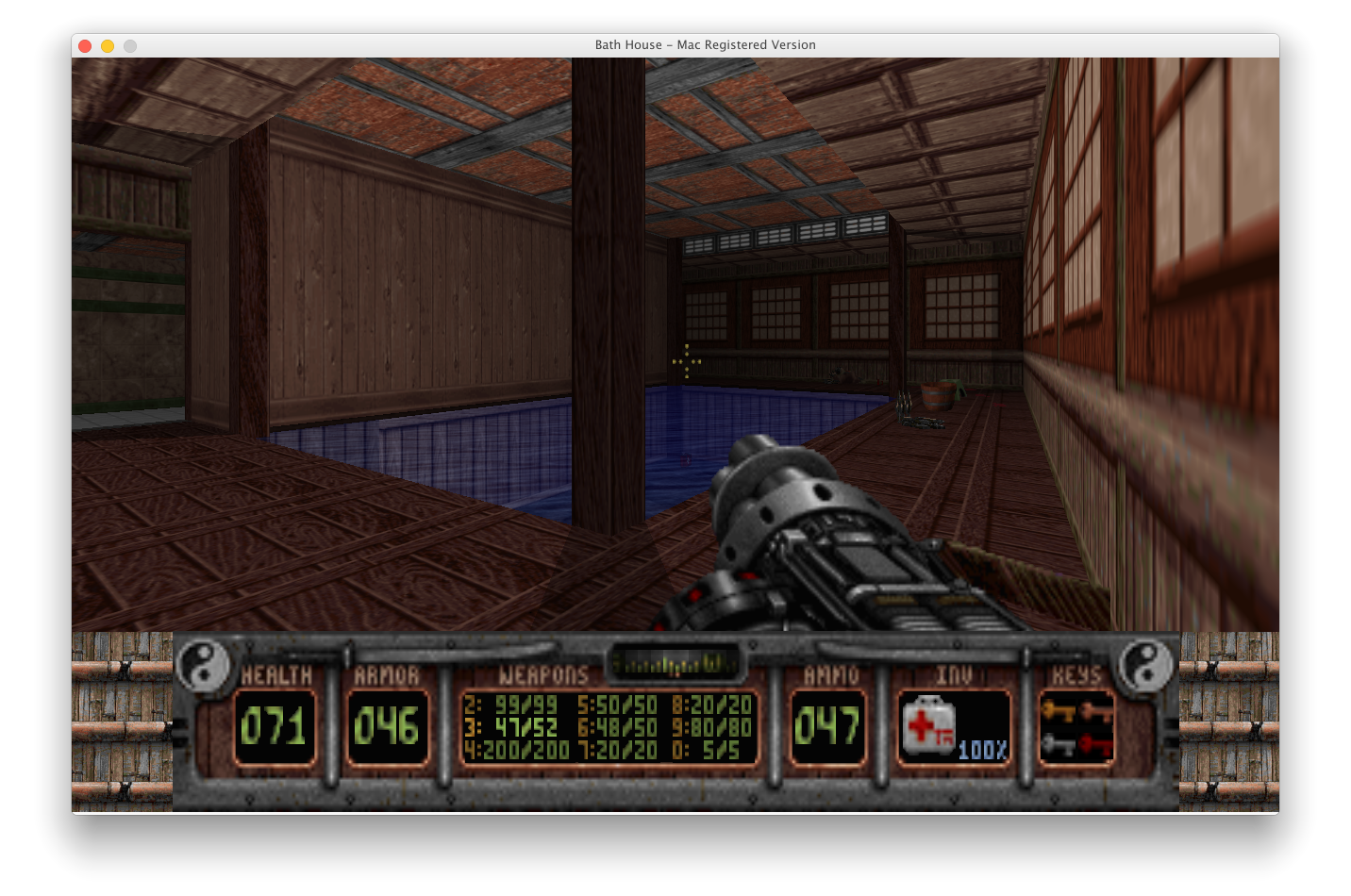
On the other hand, Shadow Warrior was probably the most technically superior of the Build games (with the possible exception of Monolith's Blood): more sophisticated sector effects, coloured lighting, true transparency (including water, though used sparingly to avoid spoilers and performance issues), fog and clouds, larger levels, room-over-room effects and the part I liked the most (and was curiously missing from the classic Mac OS port by MacPlay-Westlake Interactive), voxel-based objects that were truly 3D. All of these features plus OpenGL have made it to JonoF's Shadow Warrior Port (JFSW), using Ken Silverman's Build and Polymost engines (more info).
JFSW builds pretty much out of the box with SDL 2; just type make (or make -j24 or such to exercise your other cores), then copy the .GRP group file from either the 3DRealms shareware install or a registered or retail version to ~/.jfsw (I used my MacPlay CD and named it swmac.grp). Shadow Warrior used redbook audio for the retail version, so for music, rip the tracks and save them as track02.ogg (intro) to track14.ogg ("Lo Wang Raps") in the same directory. Then go to where you've built JFSW and start the game with ./sw, and a configuration window will appear to select your resolution. Note that while widescreen resolutions are supported (and look good), the game still uses 4:3 assets, so things like Lo Wang's sword will be cut off.
A note on resolutions and colour depth: 8bpp modes are rendered 100% in software, which is very fast even on Blackbirds with just BMC graphics, and works beautifully on virtually any system. If you select a 24bpp mode, the game will try to use OpenGL. On my system this caused a freeze (actually an infinite loop, once I stepped through it in a debugger) whenever it attempts to render reflections in a mirror. This appears to be related to non-POT texture support which virtually every card anybody would be running probably supports properly. If you get the same freeze, kill the game and edit jfbuild/src/polymost.c. On line 4903 or thereabouts you'll see if ((method & METH_POW2XSPLIT) && (tsizx != xx)) which if you change to if (0) will get around the code that glitches. I can't tell if this is specific to my card, to OpenPOWER or to gcc, and it doesn't happen in software mode, which plays 100% fine all the way to the end including nuking Zilla himself.
Firefox 109 on POWER
Firefox 109 is out with new support for Manifest V3 extensions, but without the passive-aggressive deceitful crap Google was pushing (yet another reason not to use Chrome). There are also modest HTML, CSS and JS improvements.
As before linking still requires patching for bug 1775202 using this updated small change or the browser won't link on 64-bit Power ISA (alternatively put --disable-webrtc in your .mozconfig if you don't need WebRTC). Otherwise the browser builds and runs fine with the LTO-PGO patch for Firefox 108 and the .mozconfigs from Firefox 105.
In case you thought AIX had a future

We've got a long history with AIX here at Floodgap Orbiting HQ when I first worked with AIX 3.2.5 and 4.1 in my University employment and consulting days, and I've run personal installations of AIX as my primary personal server since 1998, first on an Apple Network Server 500 and now on a 8203-E4A POWER6 p520. AIX 3 and 4 were surprisingly compelling workstation and server OSes for the time, but AIX 5L was where it started to feel "legacy" and unloved, and IBM has always been tightfisted about APARs and other kinds of updates if you don't buy a support contract. Combine that with nonsense like Capacity on Demand, where my second CPU was locked out after a system planar update until IBM coughed up a new set of keys, and I've already concluded this will be my last AIX server. While the next one will almost certainly be OpenPOWER, I'll probably run FreeBSD instead.
And, well, IBM would rather you ran Linux anyway on Power hardware, and so would their subsidiary Red Hat. If you're still an AIX institutional customer and you're still paying the bills, you'll still get support (just as you would with IBM i, the other white meat), but newly migrating to AIX is increasingly more trouble than it's worth paying for. Apparently IBM thinks so too.